What to Pack for Eternity

I walked away from my exploration of the Egyptian Antiquities section of the Louvre yesterday with two impressions: 1) I’ve taken the Christian idea of heaven for granted and 2) burying someone in Ancient Egypt sounds super stressful.

Re: the first impression. Growing up Christian, my sense has always been that my choices here on Earth determine whether I will make it into heaven, and if I do, then everything I need in the afterlife will be taken care of by God and the angels once I’m there. Although I’ve never been to one, I’ve pictured heaven to be like an all inclusive beach resort in the Caribbean (minus the problems of income inequality and other legacies of colonialism).

From the artifacts I saw and the audio commentary I listened to at the Louvre, the Ancient Egyptian conception of the afterlife seems to be much more BYO and DIY. For instance, in one display there was a well worn chair, a mat, and a fly swatter that had been placed in tombs to be used by the deceased. In another room, I saw a picture of a princess depicted with the food she would need. Most curious were cases filled with servant statues–small replicas of a person meant to take their place in the work shifts one must complete in the afterlife.

With all that was required for life after death in Ancient Egypt, it seems to me that the pressure would be on the loved ones of the deceased to provide. What if the family had only one chair? Does it go in the tomb or stay in the house?

The living would also be responsible for making sure the deceased was mummified properly, which from my understanding of the audio commentary was how people made it into the afterlife. Whether there was some moral component or salvation on top of that like there is in Christianity, I’m not sure.

I don’t know enough about Ancient Egypt, and I have my childhood self to blame for that. When I was in grade school, I had a family member buy a book about hieroglyphics for me. I was determined to learn the material on my own, but I gave up after only a few attempts.

To think if I’d persevered, I would have been able to translate what I saw yesterday rather than relying on the audio commentary.

Regrets! I hope I don’t take too many of these into the afterlife.

Preparing for Normandy

I had a lot in common with the man sitting beside me on the plane to Paris this summer. We were both Midwest transplants now living in the South, we were both wearing compression socks, and we were both highly anticipating our upcoming trips to Normandy.

He would depart for his shortly after we arrived in Paris, and his tour would take him to several sites culminating in Hitler’s Eagle’s Nest. I still have some time before I make my way to Normandy for a day long tour of the five D-Day beaches, but I’ve been preparing for awhile now.

Like my general understanding of French history, my knowledge of what happened on D-Day has come and gone a few times over my lifetime. I’m sure I knew something about it in high school when I took AP US History and the movie Saving Private Ryan premiered (although I didn’t see it). I probably touched on it again in college when I studied abroad in Europe.

But most of what I knew then has been lost. So to prepare for myself for my Normandy tour, I’ve watched the first few episodes of Band of Brothers, I’ve listened to an abridged version of Stephen Ambrose’s D-Day audiobook, and I’ve visited the French Army Museum in Paris. On the plane, along with the man beside me, I watched The Longest Day, a 1962 film about the Normandy landings.

The films and the audiobook tend to jump around between different units, and my lack of knowledge of military terms (e.g., division, regiment, etc.) has kept me from following the storylines of any individual or group very well. But I have a sense of the larger picture now.

Here’s what I’ll be thinking about when I make my trip to Normandy and what I’m thinking about today on the 75th anniversary of D-Day:

  • The extent of the physical obstacles the Allied soldiers faced on the beaches like land mines, barbed wire, barriers, the terrain, and the sea itself. Laden down with equipment, the troops navigated these obstacles while under intense fire from Germans positioned above them. They had to pass fellow soldiers lying dead or wounded on the ground.
  • The magnitude of the Allied fleet that came to launch the attack: 7000 ships and landing craft with 156,000 Allied soldiers landing at Normandy.* There’s a scene in The Longest Day (that my seat mate on the plane had me watch for) where a German officer in a beach front barricade looks out to the horizon through binoculars and a wall of Allied ships appears before him.
  • The French citizens in the towns behind the beaches who were waiting to be liberated after four years of German occupation.
  • The problems that clouds and the weather introduced, making it difficult for the Allied air fleet to drop the paratroopers in their designated zones and to carry out an aerial bombing of the German defenses along the beaches before the infantry troops came ashore.
  • The extent of the casualties among the Allied troops: over 10,000 with 4,414 of these confirmed deaths.**

As overwhelming as they are, these numbers represent one day in a war that lasted years. Learning about D-Day has reminded me of all the things I don’t know yet about World War II. Like what else happened on the Western front and what happened on the Eastern front, in North Africa, and in the Pacific theater.

The horror of D-Day is overwhelming and to continue to follow it means coming to grips with even more horror–military campaigns, concentration camps, and atomic bombings.

Knowing history can’t change it’s course, but I find I’m scared to learn it. Part of me wants to hide from the horror, but there’s another part of me, a stronger part, that wants to honor the memory of those involved by learning their stories in Normandy and beyond.


*From BBC News article “D-Day: 10 things you might not know about the Normandy invasion”
**From the Wikipedia entry on Normandy Landings

Living Inside Our Simulation

Their glasses raised in the air, the three women held their arms fixed in a cheers pose while one of them captured the moment for posterity.

Did they even toast? I thought from a few tables away in a Barcelona restaurant catering to diners looking for healthy eating options and Instagram worthy plating.

I judged them as I’ve been judging most of the photo hungry diners and sightseers I’ve encountered on this trip.

Like the tourists who cruise from room to room in the Louvre with their camera fixed in front of them seemingly snapping anything that comes into view. I judge their lack of “experiencing the art” as I listen to in depth commentary on my museum app. After I’ve learned from the audio track, I take a picture like I’ve earned it.

I’m not above it all. The morning of the simulated cheers described above I’d woken up early to run along Barcelona’s beachfront. I’d biked the path the day before, and while I was biking it, I’d thought about running it. While I was running it, I thought about when I should stop to take the best picture.

Eventually, I came across sleek outdoor adult fitness equipment free to access–basically an adult jungle gym with two long sets of monkey bars, dip bars, pull up bars, a landmine, and other things.

I’ve been working on my pull up, and I couldn’t pass up the opportunity to hang there for a bit. Literally hang. That’s what I do on the pull up bar since I can’t yet do a pull up.

So I hung, staring out into the ocean, hoping the setting would make what’s usually a crappy task (honing grip strength–i.e., making callouses) more fun.

But I found right away, that instead of “being in the moment”, I was caught up in the process of making the moment. While I hung, I thought about how I should take a picture. I thought about how I might write up a social media post about it. Instead of living the moment, I was creating the moment and processing it through the potential lens of others.

I was aware that I did not want to be doing this, but I couldn’t stop myself. (In general, I have a hard time stopping thoughts I’m trying not to think. Maybe you can relate.)

Today I climbed a hill in Clermont-Ferrand, France, and I faced the same problem when I arrived at the top: capture the moment versus be in the moment. I started first with capturing it. I took as many pictures as I wanted. I thought about texts I would send David describing my summit. And then I sat down and relaxed into what felt like “the moment” I should be experiencing.

Going forward I’m going to follow a similar strategy: document first then let whatever happen. Because I like taking pictures and I like sharing. And I think those are part of what make a moment and an experience now in our culture.

A toast is no longer just words and a clanking of glasses. It can also be a picture of arms held aloft accessible from anywhere if the user chooses to share it so.

Here’s my hilltop:

IMG-1024

And my pull up bars:

pullupbar

Remembering Enough to Never Forget

I was walking toward the Bastille Market on a Sunday morning in Paris searching my mind for information that’d been lost.

What the heck is Bastille Day about again?

I celebrated it once on July 14, 2008 when I lived in Ferney-Voltaire, a small French town outside of Geneva, Switzerland. I celebrated it again last year in 2018, watching the elaborate Eiffel Tower fireworks display from a street in Paris. On both occasions, I’m sure I’d done a Google search to learn more about the holiday.

Still, nothing appeared in my memory besides the general category “Bastille, the storming of.”

When? Why? Who?

I found the answers to my questions a week later at the Army Museum in Paris. Making my way slowly from room to room and sign to sign, I read about the military history of France from Louis XIV through World War II.

I learned about how the French came to the aid of the Americans during the Revolutionary War (1775-1783) and then had their own revolution overthrowing the French monarchy a few years later (1789-1799).

I read about Napoleon’s wars–how power went back and forth between French royal families and Napoleon and his heir. There was a brief moment where I might have understood the succession of rulers, the Republics, and how it all fit together but it didn’t last long.

I moved on to the World War I and World War II sections of the museum. I learned about the toll of trench warfare in the first war and the extent of German occupation in France during the second. I watched video clips from D-Day and the liberation of Paris. I observed how tall Charles de Gaulle was in images of the latter.

When will I forget that he called on French people to resist German occupation despite the armistice agreement between France and Germany? When will I forget how tall he was?

Since my trip to Europe last summer, I’ve been fascinated with history. What frustrates me about studying it, though, is how quickly the facts and figures fade from my mind. I know it’s not possible to retain everything. But I want to be able to remember enough to never forget the price so many have paid for freedom.

Memorial Day in the United States came the day after my trip to the Army Museum. I remembered well this year.

Enlight163

Note: The July Column at the Place de la Bastille. The storming of the Bastille took place during the French Revolution in the late 1700s. The July Column commemorates events during the July Revolution (Second French Revolution) in the 1830s.

11000 Virgins and a Sock in My Shoe

My first day at the Louvre, of what will hopefully be many, I stood in front of a reliquary bust of St. Constance in the Italian sculpture section.

The look of the figure attracted me first, but it was the description translated into English that held my attention:

“[O]ne of the 11,000 virgin martyrs, companions of St. Ursula.”

Now the idea of a virgin martyr didn’t shock me. Growing up Catholic, I have read about the lives of more than a few. But the number 11,000 was a couple orders of magnitude higher than I would expect to be martyred in a single episode.

Page 1 of my Google search results substantiated my numerical suspicions. The Wikipedia page for St. Ursula suggests ways the figure might have been misconstrued in Latin. However, despite evidence of artificial inflation, the legend of St. Ursula and her 11,000 companions remains.

By the time I was standing in front of the bust of St. Constance contemplating the ranks of her martyrdom, it was late in the afternoon, and I had made peace with the sock gathered around my midfoot in my right shoe.

Earlier in the day, I had not been so tranquil. My first hour walking around Paris Saturday morning was spent reaching down into my shoe tugging at the sock so it would come up around my heel. I tried folding the little bit of extra material on the end of the sock around my ankle but nothing helped.

That sock wanted to be inside my shoe. So eventually I just left it in there–swapping the repetition of the heel slip for the steady discomfort of the midfoot bulge. Letting go of the struggle turned out to be the remedy. Rather than waiting for the sock to slip, I let it stay there and teach me its lessons:

  • Don’t trust a new sock with a long day’s journey.
  • Find a way to sit (or in this case stand) with discomfort.
  • Even an expensive sock can let you down.

I returned to the Louvre two days later and visited St. Constance again. She looked the same as did her story. But my interpretation of it had changed…as had my socks.

Tuesdays with Toes – The Makeover

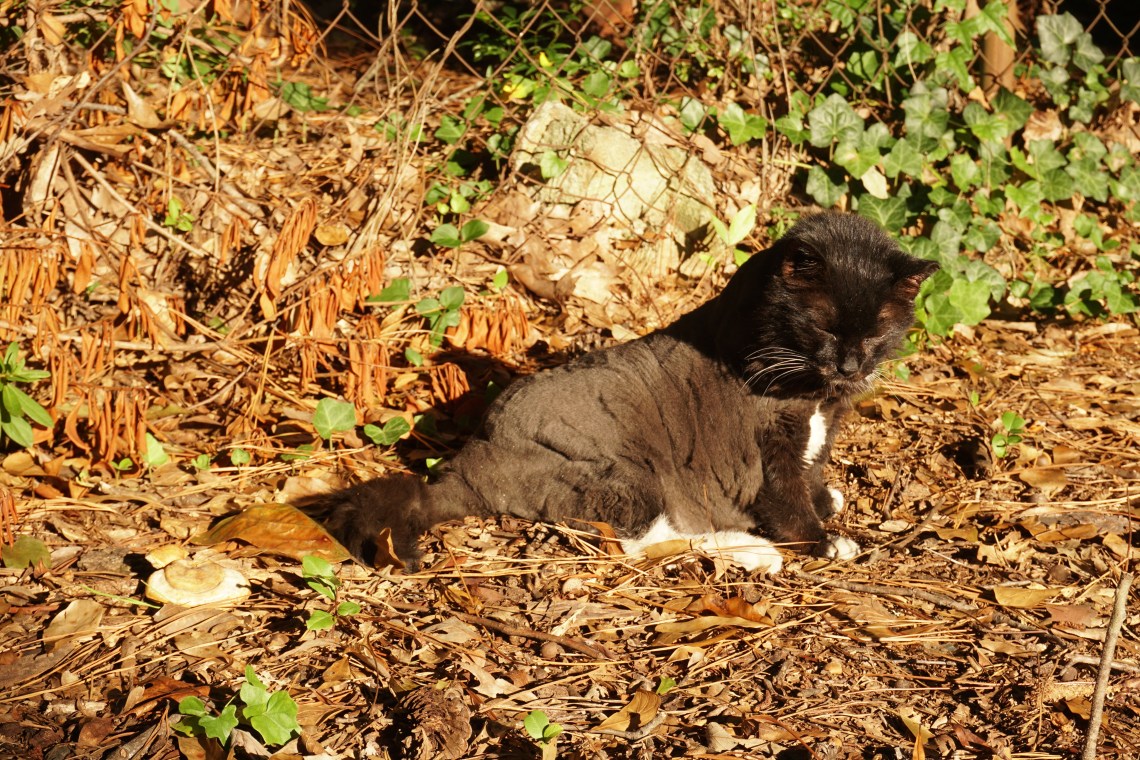
The first time I took Toes to have mats trimmed from her fur I went to a groomer. He attempted to put a plastic collar around her neck to keep her from biting and scratching, but she was ultimately deemed too hostile.

The same thing happened when Toes went to the vet for a hair cut and a checkup. They told me the visit would be more pleasant for her if she had a sedative beforehand so we rescheduled for a later date.

The process of giving Toes the sedative was not sedate. I thought I’d be able to administer it easily since I was used to giving her fluids, but she was not having that pill. Her writhing in a towel as I tried to make her swallow is one of my worst memories of my time with her. Right along with that is her appearance after the drug took effect—her back legs immobile. I worried she’d never walk again.

When I gave Toes the sedative before her vet visit, I pictured her enjoying it like a housewife taking a Valium. She’d relax, have her hair done, and emerge glamorous.

I should have known better—most of the change I’ve undertaken in my life hasn’t been pretty. I’ve never movie montaged my way from glasses gal into swan. I’ve either made hard fought slow progress, barely noticeable day to day, or resisted change until I was forced to make it. In the latter cases, I was often heartbroken–picking up shattered pieces of myself that never fit together the same way again.

I’m at the end of a period of change that feels like it’s been a couple years in the making–a mix of heartbreak and slow progress. I’m happy with where I’m at now–excited about new endeavors and making peace with the old.

Change brings beginning and endings, and one of the things I’m ending now is this series. It’s been a joy writing about my life with Toes–remembering the small moments I had with her like when she came home after her fur trim and was so soft to pet.

I loved petting her, I loved being with her, and I’ve loved sharing our story here. Thanks for tuning in to Tuesdays with Toes.

DSC03506.JPG

Tuesdays with Toes – Strange Places

The strangest place I ever went with Toes was a tire shop in Lexington, Kentucky. We were driving back from Cincinnati to Atlanta together–she in her carrier in the back seat and me alone in the front when the low tire pressure light came on. I’d had a tire fixed right before I’d come up to Ohio to pick her up so I didn’t want to take any chances. I took the next exit to have it checked out.

Luckily, I had some practice navigating road trip tire troubles before this. I’d blown a tire going over a gnarly pothole when David and I were taking a road trip from Atlanta to New Orleans. We ended up in Saraland, Alabama for the night biding time until the local Pep Boys opened in the morning.

Toes and I ran into our troubles early in the day. Off the exit, we found a tire shop that bore the last name of a girl I was briefly best friends with in middle school (a time of frequent friend turnover). The guy working the front desk knew relatives of mine from his high school days in Cincinnati so we bonded right away like good former Ohioans.

He told me to pull the car into the shop, and it was fine if Toes stayed in the backseat.

It was a large body shop that felt like a warehouse–dark concrete walls echoing sounds of scratching metal. They hoisted the car up and removed the tire for inspection.

I waited by the car–staring in the window to Toes’s carrier. I wondered what she thought of all of it–the tilt of the car and the sounds of the high pressure equipment being used in the shop.

“It’s okay Sweet Girl,” I reassured her.

And it was okay. It turned out it wasn’t the tire I’d had repaired that needed fixing but another one. They removed a twisted piece of metal from it and were able to patch it up so Toes and I could be on our way. Back to Atlanta and our lives together there.

Tuesdays with Toes – Hunger

Last week I was driving home from the gym approaching a stop sign when a striped orange cat crossed the road in front of my car. Inside the cat’s mouth dangled a plump dead mouse, it’s tiny tail pointed down.

The cat reminded me of my parents cat, Orange-y, who was born to a stray cat named Mama on their porch. Mama would be spayed but not before she gave birth to mini-Mama, her look-a-like, and Socks, who Toes resembled and who she was named after.

Seeing the orange cat with the mouse reminded me of a similar experience I had in London last summer when I spotted a black cat like Toes capturing a mouse on the city streets. I snapped a blurry picture, which you’ll find below.

Seeing the stray cat in London made me think about Toes’s life before we rescued her. She must have hunted. How successful she was at it I don’t know. Although I will say when we dangled a play mouse on a string in front of her, she pounced with a fierceness that frightened me. And she loved eating. Wet or dry food–it didn’t matter–her jaws would chomp together mashing her vittles with a wet gravelly breath followed by a shallow swallow, consuming the food as fast as she could.

Her vet told us that at some point her chronic kidney disease might decrease her appetite, indicating she was nearing her end. As far as I know, that never happened. Toes stayed hungry.

IMG-5944

Tuesdays with Toes – Empty Spaces

I went home this weekend to visit my family in Cincinnati. There were many happy reasons for the trip–Easter, my aunt’s birthday, and spending time with one of my closest friends who was also in town. There was also a sad reason–I wanted to be where Toes was before she passed away.

The kitty litter was gone from her room in my parent’s house as was her cheetah taco bed. There were no signs of her fluids or her food.

“She’s really gone,” my mom said to me while we were in there.

Back in Atlanta, David had plans to clear her stuff from our garage during my trip. He checked with me in advance, and I knew what he proposed was the right thing to do. But I didn’t like it.

“I don’t want to move on from the time with her in my life,” I told him.

Accepting the reality of Toes’s death not only means coming to terms with the fact that I no longer have a cat but also facing the inevitable march of time and how death will continue to change the landscape of my closest relationships.

There are spaces now that are filled by people I love, and like Toes’s garage, one day they’ll be empty of them.

Tuesdays with Toes – The Tropical Storm

It was windy this past Sunday, and on Monday morning before it was light out, I drove past a downed tree–a large one–on my way to the gym. It reminded me of an experience Toes and I shared a couple of years ago.

September 11, 2017–the day Hurricane Irma came to Atlanta, GA. By the time it arrived, the hurricane had been downgraded to a tropical storm. But Atlanta still braced for it’s impact.

I was living by myself in our house at the time. David had gone to Madison, Wisconsin for a few months on a sabbatical. Toes was here with me, living in the garage.

We knew the storm was headed our way for days ahead of it. And on those days, I worried. All the news stories leading up to the storm talked about how many trees in Atlanta would come down. We had a large beech tree in our front yard that had been deemed high risk for falling by a tree company. A date had been scheduled for the tree’s removal, but that date wasn’t for a month or so.

On the day of the storm, I gathered my emergency supplies, watched the weather radar, and waited. Our garage is only accessible from outside our house so I knew once the storm started Toes and I would likely be separated for awhile. Before the rain became too heavy, I went out and made sure she had everything she needed: water, food, clean kitty litter.

I tried to give Toes fluids, but she was not having it. I attributed this to the fact that animals have a sense for impending danger. I imagined her thinking, “I don’t need you to stick a needle in me right now. Don’t you know what’s coming? We might not survive.”

I did know what was coming. Before I left the garage, I scratched Toes’s head and said, “Hopefully I’ll see you on the other side of this.”

Then I went back into the house to ride out the storm. Together with Toes in a way since we were in close proximity to each other, but separate in the sense that I couldn’t reach her without going out into the rain.

I watched the storm from my couch in the living room. I witnessed my neighbor’s tree falling into a power line sending up sparks. The downed tree would hang suspended in the air between the bottom half of it’s trunk and a smaller tree on the other side of the street.

The branches of the beech in our yard swayed in the wind but the trunk stayed upright. Thankfully, that tree wouldn’t come down until it’s appointed day with the tree company. Others in my neighborhood were not so lucky. I drove past at least two downed trees that had fallen onto houses and left gaping holes in their roofs–my worst fears realized.

Toes and I were without power for a few days but other than that we emerged unscathed. Soon after the storm, Toes acquiesced to receiving fluids, and I knew then that the danger had passed.