Roadkill Radio

On road trips with my family as a kid, I liked to play a game where I pretended to be a host of a radio show about roadkill. It required a lot of vamping, and then whenever we passed an animal that had met an untimely end, I’d describe it in detail to my listeners: the bloody headless torso of a deer; a decomposing skunk who’d left behind its scent; and most often, an unidentified pile of fur. I’d always end these segments by assuring my listeners that there was a clean up crew following our radio van who would take care of the carcasses.

This week on my way to the gym for a noon workout I accidentally hit an animal–what I thought was a squirrel–spotting a split of brown fur dash underneath my car. But what turned out to be a rabbit. I didn’t feel a bump when I hit it. It was only when I slowed to a stop and looked back in my rearview mirror to see its spasming body that contact was confirmed. I made the block, and by time I returned, the rabbit had gone still. It was lying on its side, one dead eye looking straight at me.

This was the second rabbit death I’ve witnessed in my lifetime. The first was my rabbit Hoppy, who was attacked by my neighbors’ dog after the dog had jumped our fence and busted into Hoppy’s pen beneath our tree house. I watched this unfold from my dining room window, one story above the backyard. A couple months ago, I saw a rabbit being pursued by two foxes at Tilden Park in Berkeley, but I’m not sure how the chase ended because after stopping to look at us the animals dashed off the trail into the surrounding scrub.

I wasn’t sure what to do after confirming the rabbit I accidentally hit was dead so I parked on a side street, Googled my problem, and ended up calling 311. Eventually I was connected to DeKalb County Sanitation Services, but it turned out I was in the City of Atlanta’s jurisdiction when the incident occurred. After repeating my story to four different telephone operators, some of whom reacted with what I felt was unwarranted enthusiasm for the situation, I was able to file a service request. By the time I left the gym a few hours later, the rabbit was gone–the imagined clean up crew of my youth brought to life by the Department of Public Works of the City of Atlanta.

The Special Group

Let’s say a group is a collection of people assembled together at a point in time and space. Over a duration of some sort, they form a unit: a class, a team, an audience, an assembly, a council. They interact within this unit. Talking to each other, learning together, playing together, creating together, making decisions together, witnessing together. And then their time as a group comes to an end. The season finishes, they graduate, the show closes, the meeting disperses.

Sometimes a group can forge an intense connection that makes the inevitable ending difficult. I saw this a lot when I was an improv teacher. There’s nothing quite like your first improv class–when as an adult you’re encouraged to play and connect and talk candidly about hard things with other people. I experienced it myself as a student, and it felt like magic. I belong with these people I thought then. And now, five years later, I can’t remember names or even who was in my first class. What’s more is I’ve experienced the same magic several times over with other improv classes and groups.

If there’s something I chase spiritually, it’s not necessarily a connection to a higher power but a connection to other people. I love being part of a unique collection of beings tethered together for a short burst of time–a finite unit of people in infinite time and space. And I want our connection to mean something. I want to look around a room of fellow volunteers or coworkers or gym goers or classmates or tourists and believe that for however short a period that we belong together in that space. That our togetherness matters.

Over the past couple years, I’ve grieved the end of some creative groups that meant a lot to me and the related heartbreak has made me hesitant to seek out similar connections despite the joy I might experience. I think a false notion of what’s “special” is partly to blame. See I think I thought that if I found the right group it wouldn’t end. But the truth is all groups will evolve or change or come to a close. And that’s part of what makes them special. Because even at the beginning I know there’s going to be an ending, and so I know have to enjoy this group of people and the time I have with them while I have it.

Why are they bothering Jesus with this stuff?

As a child, I attended St. Aloysius Catholic Church in Cincinnati every Sunday with my parents, my sister, my aunt, and my grandmother. A mix of stone and red brick on the exterior, the building was massive with high vaulted ceilings and stained glass windows. There was a large sanctuary in the front of the church with alters to Mary and Joseph on either side, a choir loft in the back with a pipe organ, and in between rows of long dark wooden benches with kneelers that flipped down. The floor was hard tile fading with age.

The population of the church had been dwindling for some time, which would eventually lead to its closure, but while it was still open, the small numbers meant my family could stake out our own section where other parishioners wouldn’t overhear my dad’s jokes.

There was one joke he liked to make during the intercessions when prayer requests from the congregation would be read to the crowd with the ending line, “We pray to the Lord.”

To which, we’d all respond together, “Lord, hear our prayer.”

We’d do this back and forth for every individual prayer request, and if the petitions had stacked up and this went on for awhile, my dad would lean over to whoever was closest to him (with the exception of my grandmother) and mutter with feigned irritation, “Why are they bothering Jesus with this stuff?”

When he made the joke to me, I knew he was kidding, but it nonetheless prompted an important question of faith–why does an all powerful God who has seen the world since the beginning of time care about what is happening to me, a little nobody.

(In high school, I would come to believe that God wanted to hear from me because of His love for me–a love that I was unworthy of because of sin. My attempts to gain God’s attention during this period consisted of prayers in which I let Him know that I knew I didn’t deserve His time but would be grateful if He could reveal His plan for me anyway.)

Growing up, I pictured God as a man in the sky taking note of all these requests, processing them like a high speed computer, and granting or denying them according to His divine wisdom. It was a lot to handle, but He was God–not part of the human congregation down below growing weary of saying “Lord, hear our prayer.”

I gave up social media for Lent this year. My motivation for the tech fast was to see less posts that would make me feel jealous of others’ success, but I also found relief in seeing less posts about other people’s problems.

This feels bad to say because I want to be there for people, and I think sharing on social media is a good way to reduce stigma around issues many people face but that we have trouble talking about like debt, death, mental health, etc. Still, giving up social media made me realize how limited my bandwith for this information is, and it showed me the value of attention–mine and others.

I’ve posted three times on Facebook since my Lenten restriction ended in April. I’ve wanted to share things, especially the posts I’ve written on this blog, but I haven’t felt right asking for people’s attention while I’m figuring my writing out. I’ve conserved my own attention by only checking social media sites on Tuesdays.

I don’t think my current social media restrictions are the “right thing to do” on a moral level, but on a me level, it’s been the right thing for now. Because I’m not an all powerful God who can handle everything. I’m a little nobody trying to make good of some of the moments I’ve been given. A little nobody who wants to be there for people, who wants to share, but who hasn’t figured out yet how much I can bear witness to while still retaining the ability to create and connect.

The Toes Girl Bear

This past weekend David and I travelled to Gatlinburg where we met my family and stayed in a mountain cabin. Like most lodging in the area, the place was filled with woodsy themed decor, but unlike past places we’ve stayed, the decorations in this cabin were contemporary. For instance, over the couch there was a dark toned, broad stroked painting of a deer head that when caught in reflection in a facing window made it look like a real deer was out on the deck.

The main room featured lamps and a chandelier constructed from faux(?) antlers and in the downstairs bedroom there was an intricate metal stamped cutout of a man fishing in a pond. At the bottom of the stairs on the lower level hung a canvas print that listed the cabin rules–one of which was RELAX. RELAX. RELAX. I spent most of the weekend wearing bear pajamas in observation of this mandate.

My favorite piece of decor was a small bear statue with a humped back and stretched out neck that reminded me of our cat Toes. It’s been almost seven months since she passed away, but David and I still talk about her daily often repeating the phrase Kitty Cats. Toes Girl. That’s our girl. in a singsongy way and meowing at each other in Toes fashion (e.g., with a radar meow). During our stay at the cabin, David arranged it so the Toes like bear statue stood under a faux (for sure) potted plant, paying tribute to Toes’s penchant for sniffing at the bushes in our back yard. I don’t have access to a picture of Toes engaging in this exact activity, but you can still observe the similarities below:


Mementos: First 5K Race Shirt

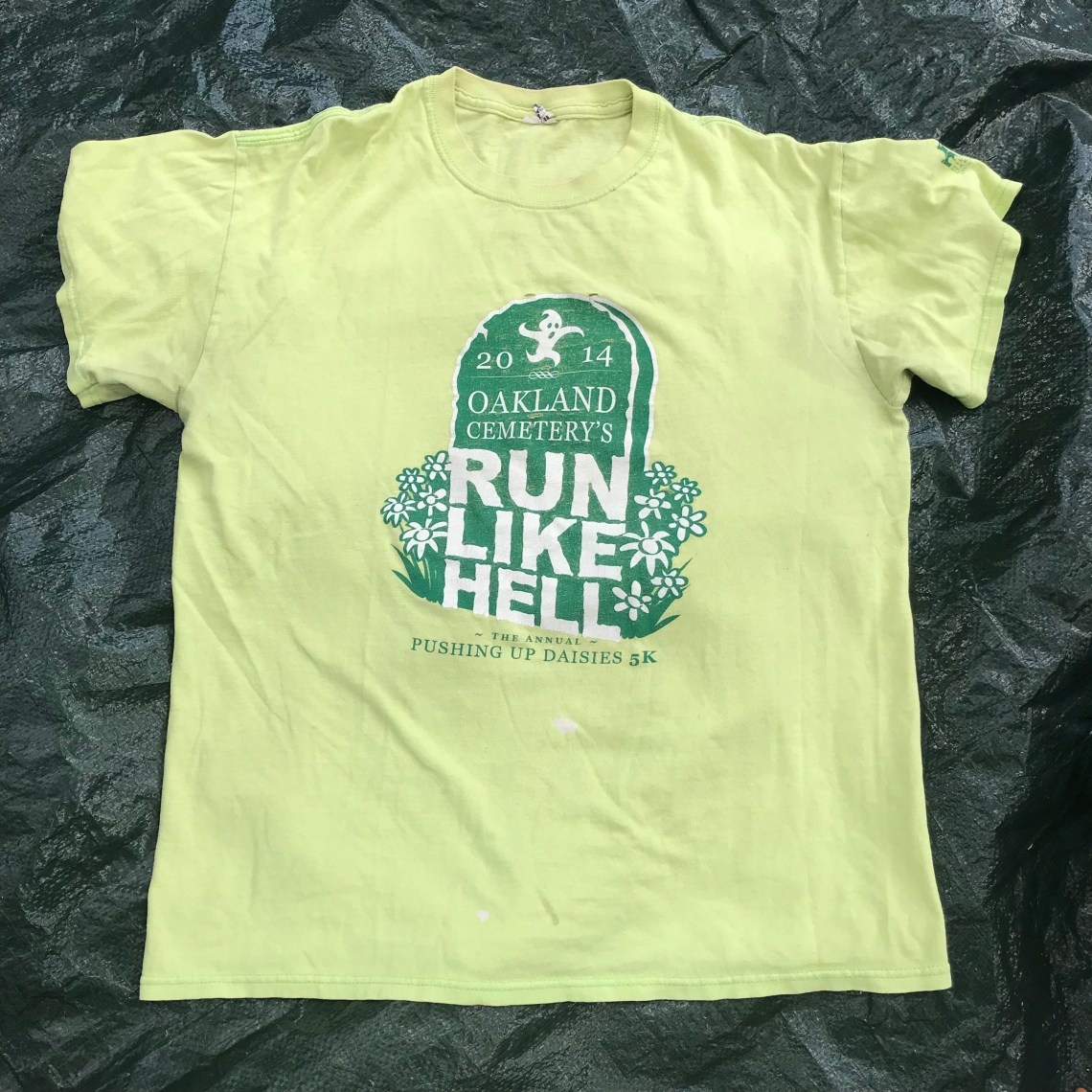
Cleaning out my garage this past Sunday, I came across a t-shirt from the first 5K race I ever ran: the 2014 Run Like Hell Pushing Up Daisies 5K at Oakland Cemetery

IMG_3204

I signed up for the race because I wanted some accountability for exercising. I knew I’d have to train if I was going to run a 5K, and I figured given my love of cemeteries, I would have sufficient motivation to stick to my training plan if I signed up for this race.

Looking at the t-shirt now, I can’t help think of it as a sign of what was to come. Within the past year, I’ve become both a personal trainer at a gym and a volunteer tour guide at Oakland Cemetery.

I also ran my first marathon this past March–five years after my first 5K. The marathon course travelled all around Atlanta, but my favorite part was around mile 24 when we ran past the gates of Oakland Cemetery. Because I knew then how far I’d come.

Becoming Fagin

As an eighth grade girl, I was cast as Fagin, a 19th century old man leader of a gang of pickpocketing British boys, in my grade school’s production of Oliver! To this day, it remains one of my favorite roles of all time.

This weekend I went to see Becoming Nancy, a new musical at The Alliance about a fictional high school boy in a London suburb in 1979 who is cast as Nancy in his school’s production of Oliver Twist even though the role he wants is Fagin.

The premise of the musical captured my attention because on the surface my situation seemed to neatly transpose that of the protagonist. But while my casting as a man caused nary a stir in my Catholic community in Cincinnati in the mid-1990s, the musical’s protagonist being cast as a woman–and the love interest of Bill Sikes, a character played by a boy–results in far more controversy.

There was the fear of homosexuality in the musical’s plot that wasn’t an issue in my school’s production. Things might have been different if I’d been cast as Bill Sikes opposite my friend Kelly’s spectacular Nancy. (Despite being only fourteen at the time, she’d been preparing the role for years.)

There was the fact that I’d already broken the gender barrier the year before in the Wizard of Oz by playing the Tin Man, a role so blatantly for a man that it’s in the character’s name.

Whatever the reason, I was able to play these roles without encountering any criticism or pushback. And I had fun portraying men. Sure, I thought maybe it would make the many, many boys I had a crush on less likely to like me. But it meant I got to play these tough, protective, and funny characters, which was the kind of kid I was.

What interests me looking back now is how normal it seemed for me to play a male character while it seems impossible that a boy in my grade school would have played a female character (and not just because the pool of girl talent was STACKED). A girl playing a boy was to be expected while a boy playing a girl would have undercut his masculinity.

When I think of the patriarchy and all it denies women, it makes me upset. But I’m also upset by what it denies men. As a girl, I was given free reign to explore what it meant to be a man, right up on stage in front of everyone–finding my heart as the Tin Man and steering little boys toward crime as Fagin. The boys in my class never would have had the chance to experience the compassion of Nancy, who takes Oliver under her wing, or Dorothy’s sense of longing for home and her courage in the face of the Wicked Witch.

You could say boys could find these traits in other male characters–they don’t need to play women–but there’s something to the freedom of being allowed to play the opposite gender. I’m grateful for all the things becoming Fagin taught me. Like how to tie a tie (which I’ve since forgotten, but thankfully now we have the Internet).


I feel it should be noted that my friend Kelly also rocked the role of Dorothy, and I was proud to be her Tin Man. Also, I’m pretty sure Nancy was not murdered by Bill Sikes in our production of Oliver! 

Memorable Performances

The thing is I remember seeing Our Town when I was in grade school. It was a production put on by a local public high school. I went to a Catholic school nearby and once a year we’d take a field trip during the day to see their shows.

These performances would likely have fallen into the waste bin of my memory had it not been for one actor–a brilliant performer who led the cast in Our Town but gave his best performance as Paul in Barefoot in the Park.

I don’t know if I ever knew this actor’s name, and I have only the most general recollection of his features: tall and lanky with brown hair. This incidentally describes most every guy I’ve had a crush on in my life, and I probably had a crush on this actor.

He graduated high school before I finished grade school, and I never enjoyed the shows at his alma mater as much after he was gone. For example, I less fondly recall a production of MASH where they played the song “Suicide is Painless” on repeat through every lengthy scene change.

This past Sunday I saw Our Town at a professional theatre in Atlanta. I was hesitant to purchase a ticket because I’m trying to be thrifty right now, but every time I’d saw ads for the Atlanta show memories of watching my favorite actor as a kid would resurface. Brief flashes of him on stage that left me wondering what the plot of Our Town was and which character he’d played (either the stage manager or George Gibbs).

I’m glad I saw Our Town again and not just because Act 3 features a cemetery. The message of the play–appreciating life and our connection with others in the moment–is one that resonates with me now. And it’s an idea I’m glad that I was exposed to as a twelve year old via a performance by an actor who I can barely recall but have yet to forget.

The Front

I’m sitting on a brown upholstered chair on the edge of our green front lawn with my black bag beside me on a blue folding chair when a red dump truck comes down the street. The driver honks his horn and slows to a stop in front of me.

The passenger window descends, and the man inside, 40s or 50s wearing a buttoned uniform shirt, says to me with a smile, “You look so relaxed.”

“It’s a nice day,” I respond. And it is. The sun is out, but it’s not yet too hot. I’m seated in a spot shaded by my neighbor’s tree.

Contrary to the man’s assessment, though, I’m not relaxed.

It’s launch day for a week of major home renovations. HVAC technicians are already at work inside our house disassembling the heating and cooling system. I’m waiting on another set of workers who will remove old insulation from our attic.

I’m not sure where I should be while all this is happening. I’d started the morning with my chairs close to the house but then progressively moved them toward the street, which is how I end up talking to the man driving the truck.

“Whenever I see a beautiful woman I have to stop,” he says.

It seems more like a compliment than a catcall. And with other stressors on my plate, I don’t want to take the time to determine if this is a problematic street interaction that reinforces patriarchal norms and should be challenged. So instead I just thank him.

He rolls up his window and drives on.

I sit on the edge of the lawn marveling in my training as a woman–my ability to appear relaxed and even beautiful in the face of inner turmoil. Turmoil that eventually pushes me out of my chair and into my car on the street. Farther from the house and all that’s going on inside and barricaded from anyone that might drive by and call me beautiful.

Just Checking

I sit in my car going over details of what happened moments ago. I recall the turn of the key. I remember tugging at the door handle. The lock was tight. I know the door is safe.

But familiar circuits are firing in my mind. The heavyweight champion enters the ring and roars. Check! Check! Check!

The skimpy underdog hops the ropes. Start the ignition. Drive away. 

I envy the underdog’s quick footwork and their ability to move on.

My mind is leaden and fixed on the status of the lock.

It would be so quick to check, and it would feel so good, euphoric even. I crave certainty like a drug. And without it I’m…

Climbing out of the car, approaching the door, jerking the handle–watching the champion deck the underdog who falls to the mat. Will they survive to fight another day?

Warning Signs

The seagulls will eat your food.

This warning appeared on a large chalkboard inside a beachfront restaurant in Santa Cruz. I spotted it right after I’d been confronted by six seagulls standing at even distances staring at me while I sat on the sand eating an Italian sub. They didn’t approach, but I was with a big group at a pre-wedding bonfire.

It’s impossible to write about yourself when you’re hiding. -Kate Christensen

I read this in Why We Write About Ourselves, a book on memoir writing featuring advice from authors. I’ve hidden from other people behind ambition and professionalism and comedy. I’ve hidden from myself with drinking and consumerism and social media. I peel back these layers, and I find a person who sometimes I’m afraid of and sometimes I’m afraid for.

As you grow older, you’re going to find out how important it is to have people in your life who you trust.

This is the advice the mother of the bride gave the newly married couple at the wedding I attended this past weekend. I have a general lack of trust–something I discovered about myself this past summer when I read a book called Self-Knowledge put out by The School of Life.

I was talking about my trust predicament with a friend while sitting on a bench along the Berkeley marina. We were looking out over the bay to a foggy San Francisco on the other side. As we were talking, scraggly looking squirrels darted out from behind rocks close to our feet triggering a signal in my mind:

Danger. Danger. Danger Squirrel. 

IMG_3093