I’m afraid to just do it

I attended some really great writing workshops at the Tucson Festival of Books this past weekend.  One of the main themes to come out across panels was how fear holds us back.  

I’m often afraid.  

I haven’t posted on this blog for two weeks not for lack of content or lack of time but because I worry about making things just right before I post them.  I worry about saying something that will come across as unintelligent or controversial.  I worry about saying something that will come back to haunt me years later.  I worry that something I post will go viral.  I worry that no one cares at all about what I’m writing.  

I worry.  But I’ve found that the best way of addressing my fears is often to just do the thing I’m afraid of.  

So I’m just going to do it.  That is, I’m going to reflect on the importance of just doing it improv and writing.  The principle isn’t complicated although it can be difficult to implement.

In improv, if you find yourself talking about doing something in a scene, just do it.  For example, if you start planning a party, fast forward to the party.  The audience would rather see someone jump out of a cake than hear you talk about someone jumping out of a cake.  Action! 

In writing, I’ve come across this when authors are plotting something their characters will do.  For example, in a lead up to a bank robbery, the characters might discuss how they are going to carry out the robbery.  My inclination is that it is better to move most of this detail to section where you show the actual bank robbery unless the conversation highlights some important character traits.  Again, action!  

In both of these cases, the hesitation to take action is rooted in fear.  Can I really jump into this pretend shark tank on stage?  Can I really write this scene where the bank robbers’ plans get foiled?  Fear holds us back from committing to our choices.  

So I’ve just done it, but I’m still a little afraid.  What’s fear holding you back from?   


A Flexible Agenda

So you’ve got an idea!  That’s great.  Improv is all about making offers, and writing fiction involves following a stroke of inspiration from one point to the next until you’ve created a thing.  It’s fun to create things, and it helps to have a plan.  But just like a vacation that’s been scheduled down to the last minute can be stressful, adhering to a strict agenda in your creative work can be stifling.

In improv, you have to be willing to either kill or adapt your ideas based on the offers of your scene partner and the needs of the story.  For example, during my grad show at Dad’s Garage, I was in a two person scene inspired by the word camping.  My scene partner lay down on the floor like he was in a sleeping bag and closed his eyes.  Assuming I was his girlfriend, I knelt close beside him.

“Morning sunshine,” I said.

“Good morning, Mom!” he replied.

And just like that, I became his mother.  I had to let my idea go and adapt to this new role he had assigned me.

In improv, the main negotiation you have to do is with your scene partner.  Everything is happening quickly, live on stage, and you’ve got to align your ideas with your partner’s to move the scene forward. Writing fiction, in contrast, is a much longer process, and one where you generally call the shots behind closed doors.  Still, there are a couple of ways that becoming overly invested in an agenda can hinder your writing.

First, if you’ve outlined and planned every step of your story, then you might resist making changes when the need arises.  You’ll feel this tug in your brain, a voice saying things like “this character isn’t working,” “this chapter is going nowhere,” or “these actions are unrealistic,” and part of you will fight back, “no, this is in the plan.”  But it’s important to throw things out that aren’t working, especially in the rewriting stage.  While this can be demoralizing (the file of discarded text from my novel is nearly 30,000 words and the original draft was 50,000 words), these efforts are usually rewarded.

It’s also important not to cling too tightly to your agenda when receiving feedback on your work.  Critique partners provide great support.  They help you stick to deadlines and tell you what’s working and what’s not working in your story; however, this feedback can sometimes feel like a personal attack on one’s creativity, intelligence, etc. even when it’s constructive.  You don’t have to cater to every demand a critique partner makes, but if your reaction is to always defend your choice and refuse their advice, then you’ll likely lose your critique partner and the opportunity to improve your work.

Don’t let your ego stand in the way of the story.  Adapt, evolve, thrive.

Conflict and Character Development

This is the first of what I hope will be a series of posts about the ways improv informs my writing and vice versa.  Today, I discuss how hasty conflict resolution can impede character development.

For background, I started taking improv classes at Dad’s Garage in Atlanta in January 2013, and I wrote the first draft of my novel NaNoWriMo style in July 2013 (i.e. I completed a 50,000 word draft in a month).  I began revising my novel that August while I was taking a class on Character Development at Dad’s.  In this class, the instructor cautioned us against solving problems too quickly in our scenes, and he encouraged us to instead spend time exploring the implications of the conflict, especially for our characters.  His advice helped me see that I was rushing to solve conflicts in my novel as well and that my characters were emotionally flat as a result.

So what does resolving conflict too quickly look like?  For example, consider a two person scene where one person gets bitten by a poisonous snake:

Dude 1: Ah snake!

Dude 2: Eeeek!

(Snake bites Dude 1)

Dude 1: Oh no, man!  I’m going to die.  I just want to tell you…

Dude 2:  Don’t worry.  I’ve got antivenom.

(Dude 2 takes antivenom out of his back pocket and administers it to Dude 1)

Dude 1: Thanks man.

Dude 2: What were you going to tell me?

Dude 1: Never mind.  We don’t have to confront our feelings.  Everything is fine.

Maybe these two dudes go on to encounter a host of dangerous animals in the jungle, each one more lethal than the last, and Dude 2 has the antidote for each one.  That might be funny, but a more emotionally compelling scene would be one where these two characters confront the impending death of Dude 1 and use this opportunity to explore their relationship.  Perhaps Dude 1 has a deathbed confessional to make to Dude 2 (he’s secretly his father, his long lost fraternal twin, or the guy that’s always upvoting his posts on reddit).  Maybe Dude 2 talks about how empty his life will be without Dude 1 since they’ve been friends since they were in cub scouts together, met online playing World of Warcraft in college, or started hiking the Appalachian Trail together a week ago.  What do they mean to each other?  Why is this conflict so devastating?  These are the types of questions you want to answer – not just finding a solution to the snakebite issue.

I’m writing a romance novel, and the way conflict plays into these types of stories is that something is usually keeping the hero and heroine apart.  In the first draft of my novel, I’d identified barriers to a romantic relationship, but I ignored them and let my characters get together right away because they were attracted to each other.  Now, attraction is powerful, but as I began to revise the novel, I realized that my characters needed to respect the factors that were keeping them apart (to build suspense) and they needed to experience an emotional change that would make them willing to get together despite these factors (thus creating character arc).

There are a couple guidelines of good storytelling at play here: (1) once you’ve stated something is true, it is, and (2) actions should have consequences.  For an example of the first, what if halfway through Romeo & Juliet, Shakespeare decided that the Capulets and Montagues didn’t really hate each other thus lowering the stakes on Romeo and Juliet’s relationship? Not as compelling, right?  Instead, Shakespeare raises the stakes when Romeo slays Tybalt.  For an example of the latter, what if Romeo wasn’t punished for this?  What if it didn’t make it even harder for him and Juliet to be together?  We might have had a happy ending then, but the audience would question Shakespeare’s reality.

One of the joys of writing fiction and doing improv is constructing new realities.  You make the rules and you can break them, but if you don’t show respect for the boundaries of the world you’ve created, then neither will your audience.  Sometimes it hurts to watch our characters suffer when they are dealing with conflict, but often we’ll get the chance to see them grow.  And in the long run, their resiliency and transformation will be more emotionally satisfying than stepping in and saving them right away.

Spring Blossoms 2014

I photographed a lot of flowers last spring in attempt to capture the beauty of the season in Atlanta.  Hope to the same this year.  Here’s the first of the season (although spring does not officially start until next month).    IMG_4180

Get to Know Me at 15* (Valentine’s Day)

“Yet another Valentine’s Day has come and gone boyfriendless. This is getting pretty pathetic. 15 years of life and not one boyfriend on the ‘sacred Feb. 14.’ I’ve actually only ever had one real boyfriend. It’s really pathetic because my sister who is four years younger than me has had three boyfriends.”

An apt depiction of my early teenage years: boy crazy yet boyfriendless, envious of my little sister’s love life.

*Stuff I wrote when I was in high school.

It could be worse

I lived in Madison, WI, for a year after I finished graduate school, and my husband and I resided in a neighborhood with weekly street cleaning from April through October.  On the two days per week our streets were being cleaned, we had to make sure we weren’t parked on the specified side of the street to avoid a fine of around $30.

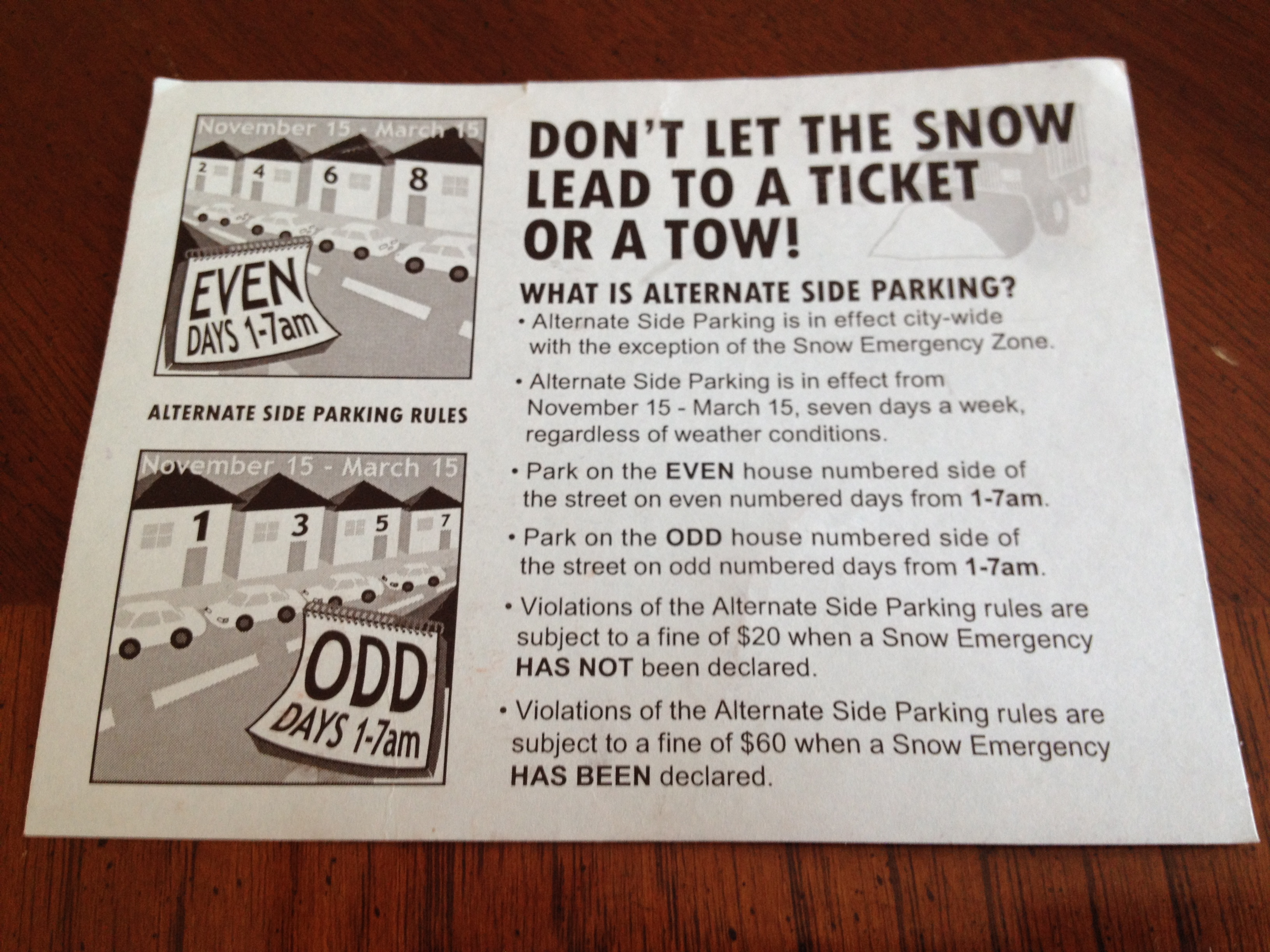
Come October, I was getting really excited that street cleaning would end.  I would look at the street cleaning sign and think to myself how carefree parking would be come November.  That is, until we received this flyer on our car window one morning:

alternatesideDavid read the flyer first and said, “We’re going to have to move our car to the opposite side of the street every day during winter.”

I grabbed it from his hands countering, “No way, that can’t be true.  It’s probably only when it’s snowing.”

As I read and comprehended the reality of Madison’s alternate side parking, my heart sank.  Now, we would have to think about being parked on the correct side of the street SEVEN nights a week rather than two.

In the end, we probably got five or six parking tickets over the course of the winter, all during non-snow emergency times.  As winter settled in, though, I came to respect the alternate side parking program because there was SO MUCH SNOW accumulating over months and months during which the temperature did not rise above freezing.  If it had not been for alternate side parking, the streets would have become really narrow as snow piled up on either side.